
Parallel parking is one of the driving skills that makes many students nervous before their ICBC road test. The good news is that parallel parking becomes much easier when you understand the steps, practice regularly, and learn how to stay calm during the maneuver.
If you are preparing for your parallel parking ICBC road test, this guide will help you understand how to approach the parking space, control your vehicle, check your surroundings, and avoid common mistakes.
At Task Driving Academy, we help students improve parking, observation, lane control, and road test confidence through professional driving lessons in Vancouver, driving lessons in Burnaby, driving lessons in Richmond, and driving lessons in South Delta.
🅿️ Why Parallel Parking Matters on the ICBC Road Test
Parallel parking is important because it shows your ability to control the vehicle in a limited space. During your ICBC road test, the examiner may assess how safely and calmly you complete the maneuver.
Parallel parking checks your ability to:
- 👀 Observe your surroundings
- 🔄 Use mirrors and shoulder checks
- 🚗 Control speed slowly
- 🛞 Steer accurately
- 🅿️ Position the vehicle safely
- 😌 Stay calm under pressure
Parallel parking is not only about getting close to the curb. It is also about safety, control, and awareness.
👀 Before You Start Parallel Parking
Before you begin, make sure you check your surroundings carefully. Good observation is just as important as steering.
Before parallel parking, you should:
- 👀 Check mirrors
- 💡 Signal toward the curb
- 🔄 Shoulder check
- 🚗 Position your vehicle beside the parked vehicle
- 🛑 Stop safely before starting the maneuver
- 🚶 Watch for pedestrians, cyclists, and vehicles
Never rush into the parking maneuver. Take your time, check properly, and move only when it is safe.
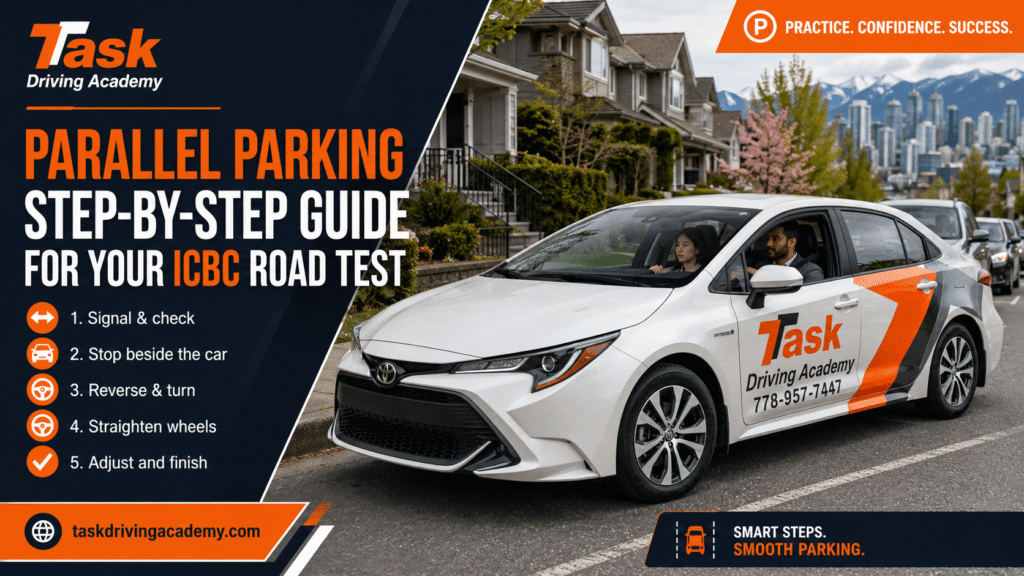
🎯 Parallel Parking ICBC Road Test Step-by-Step
Here is a simple method to practice parallel parking for your ICBC road test.
Step 1: Signal and Check
Before pulling beside the parked vehicle:
- 👀 Check your rear-view mirror
- 👀 Check your side mirror
- 💡 Signal toward the curb
- 🔄 Shoulder check
- 🚗 Move beside the parked vehicle when safe
Your vehicle should be beside the front vehicle with enough space between both cars.
Step 2: Line Up Your Vehicle
Stop beside the parked vehicle and line up properly. Keep your vehicle straight and close enough to begin the parking maneuver safely.
Focus on:
- 🚗 Keeping the vehicle parallel
- 🛞 Maintaining enough space from the parked car
- 👀 Checking surroundings again
- 😌 Staying calm before reversing
Good setup makes the rest of the parking easier.
Step 3: Reverse Slowly
Start reversing slowly while checking your surroundings. Do not rush. Parallel parking should be controlled and smooth.
Before reversing:
- 👀 Check mirrors
- 🔄 Shoulder check
- 🚶 Watch for pedestrians
- 🚗 Watch for traffic behind you
Move slowly so you have enough time to adjust.
Step 4: Steer Into the Space
As you reverse, steer toward the curb and guide the vehicle into the parking space. Keep checking around you while moving.
Remember:
- 🛞 Steer smoothly
- 👀 Keep checking mirrors
- 🚗 Control your speed
- 🛑 Be ready to stop if needed
If you need to adjust, it is okay. Safe correction is better than rushing.
Step 5: Straighten the Vehicle
Once your vehicle is mostly inside the parking space, straighten your wheels and adjust your position.
You should aim to:
- 🚗 Be reasonably close to the curb
- 🅿️ Stay within the parking space
- 🛞 Straighten your wheels
- 👀 Check around before final adjustments
Do not panic if your first attempt is not perfect. Controlled correction shows better judgment than rushing.
Step 6: Secure the Vehicle
Once parked, make sure the vehicle is safely positioned.
Before finishing:
- 🛑 Stop completely
- 🛞 Straighten wheels if needed
- 🅿️ Apply the parking brake if instructed or appropriate
- 👀 Check surroundings before moving again
During the test, listen carefully to the examiner’s instructions.
❌ Common Parallel Parking Mistakes
Many students make small mistakes during parallel parking because they feel nervous or rush the steps.
Common mistakes include:
- ❌ Forgetting to signal
- ❌ Not shoulder checking before reversing
- ❌ Reversing too quickly
- ❌ Hitting or touching the curb too hard
- ❌ Ending too far from the curb
- ❌ Not checking for pedestrians or traffic
- ❌ Oversteering or understeering
- ❌ Panicking instead of correcting safely
The best way to avoid these mistakes is to practice slowly and focus on control.
👀 Observation During Parallel Parking
Observation is one of the most important parts of parallel parking. The examiner wants to see that you are aware of everything around your vehicle.
During parallel parking, check for:
- 🚶 Pedestrians
- 🚴 Cyclists
- 🚗 Vehicles behind you
- 🚪 Car doors opening
- 🛒 Objects or hazards nearby
- 🪞 Mirror and blind spot areas
🧪 Practice Parallel Parking During a Mock Road Test
Task Driving Academy also offers mock road tests to help students prepare before their real ICBC exam.
A mock road test can help you:
- 🅿️ Practice parallel parking under test-style conditions
- 👀 Improve observation habits
- 🔄 Build confidence with shoulder checks
- 🚦 Practice examiner-style instructions
- 😌 Reduce test-day nervousness
- ✅ Understand what to improve before the real test
If you want to prepare properly, read our full guide on mock road test preparation.
📋 Add Parallel Parking to Your Road Test Checklist
Parallel parking should be part of your regular ICBC road test preparation. You should not wait until the last lesson to practice it.
Before your road test, make sure you can:
- ✅ Signal properly
- ✅ Check mirrors and blind spots
- ✅ Reverse slowly
- ✅ Steer with control
- ✅ Park safely near the curb
- ✅ Correct your position if needed
- ✅ Move away from the curb safely
📍 Where Students Can Practice Parking
Students can practice parking in different areas depending on their skill level. Beginners may start in quieter streets or calm practice areas, while more advanced students can practice in real road conditions.
Task Driving Academy helps students prepare in:
- 🚗 Vancouver
- 🚗 Burnaby
- 🚗 Richmond
- 🚗 South Delta
Practicing in different areas helps students build confidence with parking, traffic, pedestrians, and real driving conditions.
😌 How to Stay Calm During Parallel Parking
Many students know the steps but still get nervous during the test. The key is to slow down and focus on one step at a time.
Helpful tips:
- 😌 Take a breath before starting
- 👀 Check surroundings first
- 🚗 Move slowly
- 🛞 Steer smoothly
- 🛑 Stop and correct if needed
- ✅ Focus on safety, not perfection
A calm and controlled attempt is better than a rushed one.
❓ FAQ About Parallel Parking for ICBC Road Test
Q: What is the easiest way to parallel park?
The easiest way is to set up correctly, reverse slowly, steer smoothly, check your surroundings, and make small corrections when needed.
Q: Can I fail my road test because of parallel parking?
You may lose marks for unsafe observation, poor control, hitting the curb hard, or creating an unsafe situation. Safe observation and control are very important.
